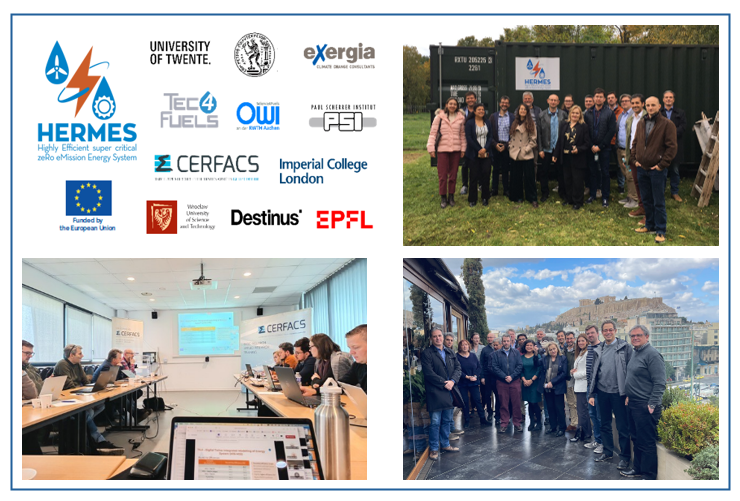
The Horizon Europe project HERMES (Highly Efficient Super Critical ZeRo eMission Energy System) has completed its work programme and delivered its final results. Coordinated by the University of Twente with 11 partners from 7 European countries, HERMES developed a closed-loop energy system built around a directly fired supercritical gas turbine running on renewable hydrogen and methanol, and validated its key technologies at laboratory scale, including hydrogen oxy-combustion in supercritical CO₂ at up to 80 bar.
Designed for net-zero greenhouse gas emissions and a target electrical efficiency above 65%, the system could cut global warming potential by more than 80% compared with the current state of the art, in line with the EU’s path to a 90% emissions cut by 2040 and climate neutrality by 2050.
EXERGIA led the project’s work on policy, market assessment and business models, as well as on exploitation and dissemination.
HERMES occupies a unique niche in the energy innovation landscape: a dispatchable, zero-emission source of power and heat that can bridge the gap between short-duration batteries and unabated gas plants, with a roadmap to full commercial readiness by around 2035. The most promising markets are flexible grid balancing, industrial clusters and Energy-as-a-Service models, with Spain and Greece among the prime locations for renewable fuel hubs.
EXERGIA’s work also shows that EU climate and industrial policy sends strong demand signals for such technologies, but the step from laboratory validation to pilot scale still lacks dedicated funding instruments and technical standards.
More information: https://hermes-energy.eu/
HERMES has received funding from the European Union’s Horizon Europe research and innovation programme under Grant Agreement No 101083748.